O send out your light and your truth, that they may lead me, and bring me to your holy hill, and to your dwelling;
That I may go to the altar of God, even to the God of my joy and gladness
Psalm 43:3-4
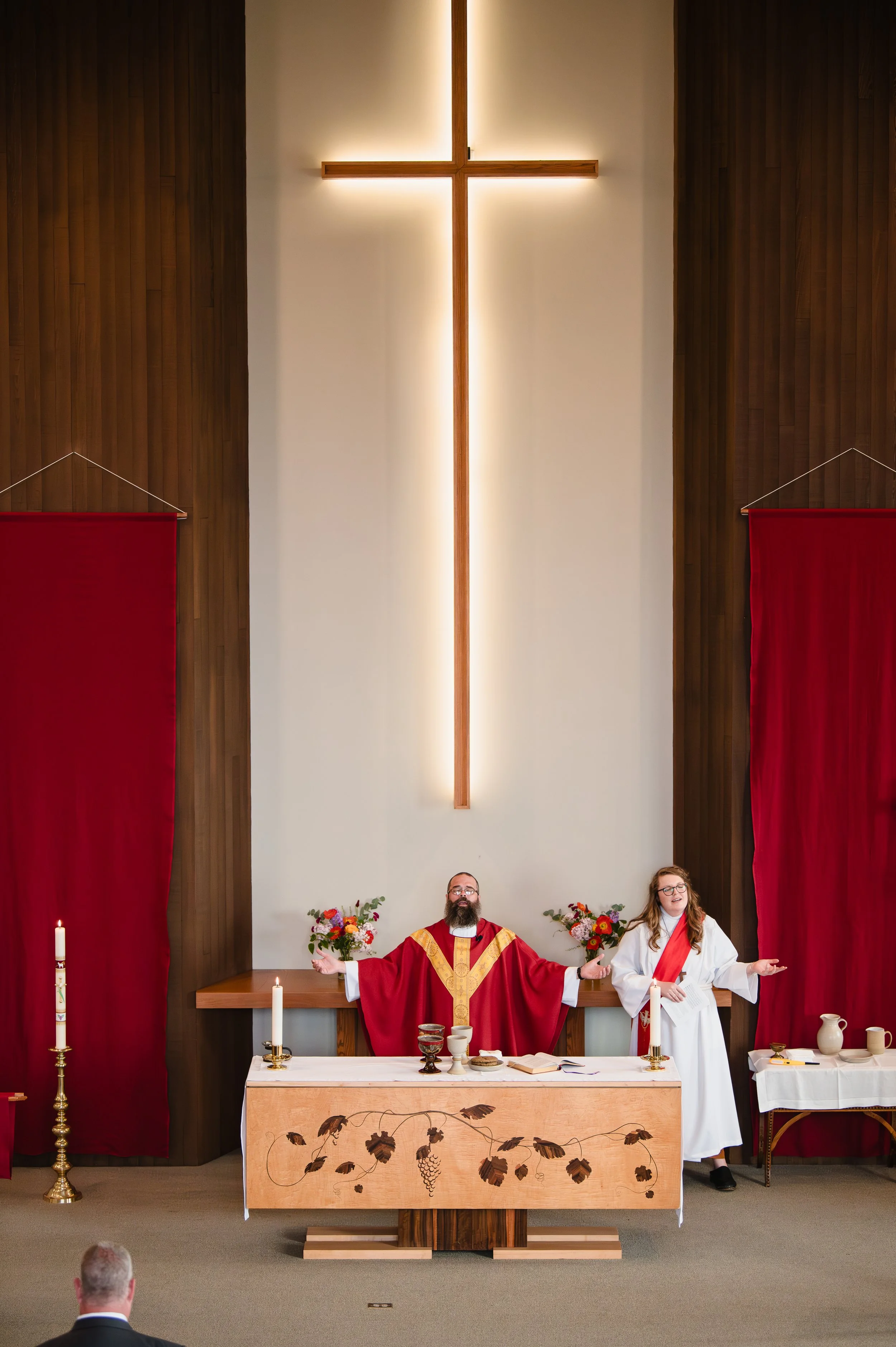
Every church has a liturgy, a form and way of worship. Cultural liturgies exist as well, bearing witness to the reality that human beings are worshiping beings. Often the word liturgy is described as the work of the people. But this can leave us detached from God; it places too much emphasis on us and our work. A more helpful description is the people’s response to the grace of God. Our liturgy is structured by the Book of Common Prayer, which is described as Holy Scripture arranged for worship. Central in our worship is the Gospel which is proclaimed, tasted, and seen in various ways in the liturgy. As our worship involves the entire Body of Christ, our services are participatory, not performative. We do not gather to be entertained. We gather to participate in what God is doing in us and among us. Participation comes in the forms of responsive prayers, chanting the Psalms, and singing hymns.
So what can you expect at most of our Holy Eucharist services? In the book of Isaiah, we read of the Lord: Thus says the One who is high and lifted up, who inhabits eternity, whose name is Holy: “I dwell in the high and holy place, and also with him who is of a contrite and lowly spirit, to revive the spirit of the lowly, and to revive the heart of the contrite.” (Isaiah 57:15) We aim to capture and experience this dual aspect of the Lord: high and holy; dwelling with the meek and lowly. Our music captures the beauty of simplicity, often being led by piano and vocals, often accompanied by guitar, cello, violin, and vocals. We sing traditional hymns, along with newly written or retuned hymns, all with the aim of praising the Lord. As our worship is about coming to the Lord and not the personality of any given leader, clergy and others wear traditional Anglican robes, reminding the Church that we are all robed in the righteousness of Christ. Human beings are embodied souls. What we do with our bodies speaks to the posture of our souls. Traditionally, we stand to praise, sit to listen, and kneel to pray. The entire service is marked by a joyful reverence. The Lord is holy to be sure. He has also put gladness in our hearts.
Let the little children come unto Me, are the words of Jesus. (Mt19:14) One of the greatest gifts and formative practices a parent might grant to their child, is their worship of the Lord. The repetition of our Holy Eucharist service trains the hearts and minds of children, whatever age they might be. We love children and desire them to be with us in the service. That said, to accommodate the needs of many, and to provide rest for parents, we provide weekly nursery care at the beginning of the service. We also offer some play time for younger children which is followed by a Bible lesson using God’s Big Story curriculum. At the Passing of the Peace–about two-thirds of the way through the service–all children join the church as we enter into the Liturgy of the Table. For nursing mothers, there is a small alcove just off the narthex that provides moderate privacy if helpful. We also provide simple coloring sheets for children of all ages so that, during the service, they have opportunity to listen and draw.
It is our great desire and prayer that you might join us, whoever you are, that you might experience the warmth of hospitality, the rest of Jesus, and the joy of the Lord.
[Photo credit: Janeen Sorenson]